DEFINITIVE REFERENCE FOR INDIAN CENT DIE VARIETIES


Home
Table of Contents
For Sale List
Numismatic Links
David's Numismatic Blog

1889 Variety 20


Obverse 22

Reverse V


Obverse Diagnostics


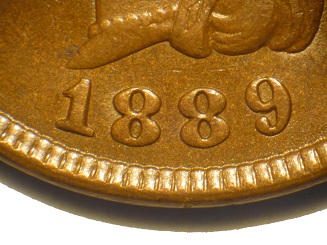
Date Position

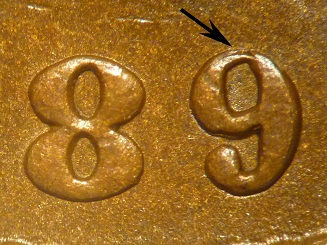
Repunched 1 to the South and 8 to the North

Repunched 9 to the North


Clash Mark from the C of CENT from Reverse V

Die Break at Eighth Feather Tip


Die Crack Connecting ER of AMERICA

Die Crack Connecting the Bases of the 1 and 8

Reverse Diagnostics


Die Crack Throough Lower and Middle Arrowheads

Die Crack Through the Olive Leaf Above Arrow Quill

Reverse Die Flow Lines


Obverse 22 is identified by Repunching to the south on the 1 and additional repunching to the north on the first 8 and 9, with date placement at RE.  Obverse 22 has developed moderately heavy die flow lines, a small die break at the tip of the eighth feather and has acquired clash marks located in front of the eye and between feathers 7, 8 and 9 from a clashing event with reverse V.  Obverse 22 develops the following die cracks:
1.  Die crack connecting the tops of ER of AMERICA.
2.  Die crack connecting the bases of 1 and 8 of the date.

Reverse V is rotated 5 degrees clockwise and is in a similar die state as obverse 22, with the advancement of moderately heavy die flow lines.  Reverse V has acquired clash marks above the O of ONE, through the C of CENT and to the right of the denomination from a clashing event with obverse 22.  However, these clash marks fade due to the reverse V die flow lining.  Reverse V develops the following die cracks:
1.  Die crack through the lower and middle arrowheads continuing upward to the second oak leaf.
2.  Die crack through the base of the knot and continuing through the olive leaves.

Comments:   The obverse 22 die crack progressions are difficult to determine due to the flow lined nature of the die state.  The reverse V die cracks may actually be one crack from the lower left side of reverse V continuing through the bottom of the wreath to the second oak leaf within the right side.  However, I cannot determine with accuracy the exact progression of the crack from the bottom of the ribbon to the lower and middle arrowheads.

The small die break at the tip of the eighth feather tip is a common die failure point most commonly seen on the later dates of the series, specifically 1899.

Plate coin:  David Killough, AU58

Return to 1889 Varieties Table

Return to Date and Die Variety Analysis