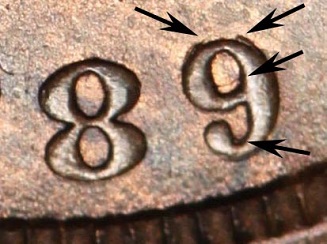
Obverse 10 is identified by repunching to the south on the 18 and
repunching to the north on the 9, with date placement at B.
Obverse 10 has developed moderate to heavy die flow lines.
Reverse J is in a similar die state as obverse 10, with the advancement
of moderate to heavy die flow lines. Reverse J develops the
following die cracks:
1. Die crack from the denticles at 1:30 downward through the
right wreath.
2. Die crack connecting the wreath stem, ribbon end and
lowest arrowhead.
3. Die crack from the rim at 6:30 upward through the left
wreath to the denticles at 8:30.
Comments:
The obverse 10 date repunching of the 18 digits is minor, with the base
of the 1 appearing to be curved due to repunching elements on both ends
of the base. In contrast, the 9 digit is more widely
repunched on all elements of the digit.
The
above plate coin, which is tentatively the finest known of the variety
8 die pairing, was within the fixed price list of Ed Nathanson and who
kindly gave his permission to use his images to illustrate variety 8
for this book.
Plate coin:
Ed Nathanson, MS63BN (Snow 5 Plate Coin)